Torrential rain, trapped and tyred!
Hola chicos y chicas.
We’ve had a long gap mainly due to not much to report and difficulties getting good wi-fi and a mobile phone sim.
When we first started cycling together back in 1989, there was no email, no internet and no mobile phones. When we set out to cycle in Africa, my family thought I was actually on the way to China ( the Tianamen Square massacre scuppered that plan ) so the first thing they knew otherwise, was an airmail letter from Nairobi! It was a very satisfying feeling to know that no-one knew where you were and you felt that you were having a proper adventure.
Gaps in communication of several weeks were usual and people didn’t really worry; the normal way of communicating with travellers was via poste restante – You told people where you were heading and they then wrote to you i.e. Steve Willey, POSTE RESTANTE, Lilongwe, Malawi, where your mail would be held for up to a month. You then went to the main post office in your destination city, showed your passport and collected any mail being held for you. When you wrote back, your letter might get passed around or someone would make photocopies and pass them around. Simples. The system is still in use so maybe we should all abandon FB, blogs, etc. and resort to non-instantaneous old-school letter writing!
Anyway, we digress.
From San Ignacio our destination was the town of Chachapoyas, a four day ride away via very asian feeling paddy fields, a short cut we’d read about that involved a very turbulent river crossing from the “port” of Rio Maranon on the Utcubamba river and a wild-camp at a mosquito and sand-fly infested petrol station.


After our interesting river crossing, we pedalled on a further 80km through hot, dusty, countryside to the sleepy junction town of Pedro Ruiz Gallo where another bug struck and Steve had a very disturbed night! We’d been looking forward to continuing our cycle up the very scenic Utcubamba gorge but decided to feed Steve more movement-stopping drugs and take a mini-bus to Chachapoyas. The original plan was to leave Chachapoyas the following day and cycle 40km to the tiny village of Nuevo Tingo, the gateway to the ruined city of Kuelap. Plans are one thing, stomach bugs are another! Bug No2 confined us to town for 4 days whilst things took their course. Felt very sorry for Michelle getting bored stiff – not exactly much to do except for a small cultural museum that contrived to be closed every time she went to visit. The only saving grace was the nice hostel we were staying in.

Once Steve was mostly recovered, we had an easy 40km cycle – 16km freewheel downhill followed by a lovely ride up a gently sloping canyon road to Tingo where we camped in the grounds of a hostel. The following day we left the bikes and our gear there and grabbed a lift 2km up to Nuevo Tingo where we took the new cable car to Kuelap. This new service takes 20 mins instead of a 3 hour hike! Last year Kuelap saw 40,000 visitors. They hope to triple that in the next year now access is easier although there’s still no airport in the Chachapoyas region so the increase in visitor numbers will be slow.
The fortress of Kuelap or Cuélap, is a walled city associated with the Chachapoyas culture built in 6th century AD. It sits at an elevation of 3000m and consists of more than four hundred buildings surrounded by massive exterior stone walls. The complex is situated on a ridge overlooking the Utcubamba Valley in northern Peru and roughly 600 metres long and 110 metres wide. It could have been built to defend against the Huari or others, but evidence of hostile groups at the site is minimal.


From Kuelap, we had another easy 50km day following the Utcubamba river up a pretty, gently sloping gorge road ( very reminiscent of small French alpine D roads ) to the small mountain town of Leimebamba where we stopped for the night before tackling our first big Peruvian climb.

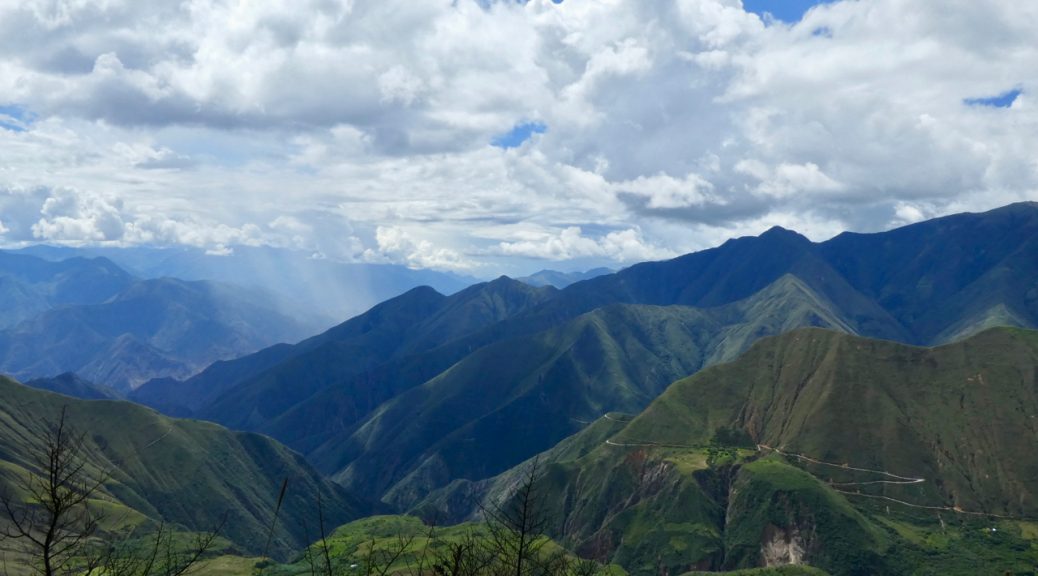
From Leimebamba we aimed to spend 3 days or so cycling to Cajamarca, some 250km away. The first day saw us cycle uphill for 30km to a pass at 3600m – not too tough really except that we twice got attacked by bees ( no action on our part – just sudden unprovoked attacks! ) resulting in Steve getting stung 3 times and us dropping the bikes on the road, running away and then sneaking very, very slowly back to get them once the bees appeared to have gone away.


The 64km, 2 hour freewheel down to Balzas in the valley was excellent although the increase in temperature not so excellent. 17C at the top and a sauna steamy 40C at the bottom. We’d read from an overland travel blog that there was a good wild-camping spot 5km on from Balzas; 200m higher up and in theory slightly cooler. So once we’d fixed a slow puncture and some scumbag kids had stolen my e-cigarette, we left Balzas for our not so good as it turned out camp spot. Very rocky, very hot and very insecty. That’s a new word I just invented.

The following morning the alarm went off at 4:50 and we were on the road by 6:30 in a bid to try and gain a bit of altitude and cooler air before it became unbearably hot. The target for the day was the town of Celendin, 55km away and over another 3200m pass – 2100m of climbing ahead of us.
After a 1000m of climbing we or rather Steve gave up and we got a lift to Celendin and then from there, a mini-bus to Cajamarca.
We’ve been on the road for 3 1/2 months now. The cycling has been very rewarding, the countries and people experiences sublime but, we’re tired. The 2500km of cycling we’ve done so far has been very physically demanding at times and we’re now running out of energy.
We’d like to cycle a bit more – up into the Cordillera Blanca and on to the city of Huaraz where we plan to get a bus to Lima for our flight home in a couple of weeks – but have a couple of issues to contend with.
Some of the roads are very tough with some 4000m passes however, the main problem is due to the extreme rainfall northern Peru has been experiencing lately causing widespread flooding, mud slides and chaos.
There are currently no buses running from either here in Cajamarca or Huaraz to Lima because the rain has destroyed several critical roads and bridges or blocked them with mud slides! The main coast road north from Lima is closed causing major problems. 80 people have died so far, 140,000 homes destroyed or damaged and at least 650,000 people displaced or affected! Additionally, as a result of the transport issues, some food prices have increased or dropped because people can’t export their produce and fuel shortages and associated price increases are affecting some areas.
The road from Huaraz to Lima was open briefly a couple of days ago but further heavy rain has closed it again with more forecast for the next 2 weeks!
We may well be stuck and there’s a possibility that we won’t be able to get to Lima in time for our flight home!
At the moment the plan is to take a bus a bit further south then cycle the remaining 500km to Huaraz and hope that the situation improves enough over the next 10 days to allow us to get a bus to Lima.
What we don’t know is – will the roads re-open in time and if they do for how long? how many other travellers are stuck in Huaraz and will there be space on a bus if the roads do re-open? We’ll be cycling on some very tiny, high, remote dirt roads that themselves may or may not have rain-related issues. Exciting!
Watch this space!