Browsed by
Month: March 2017

Torrential rain, trapped and tyred!

Torrential rain, trapped and tyred!

Hola chicos y chicas.

We’ve had a long gap mainly due to not much to report and difficulties getting good wi-fi and a mobile phone sim.

When we first started cycling together back in 1989, there was no email, no internet and no mobile phones. When we set out to cycle in Africa, my family thought I was actually on the way to China ( the Tianamen Square massacre scuppered that plan ) so the first thing they knew otherwise, was an airmail letter from Nairobi! It was a very satisfying feeling to know that no-one knew where you were and you felt that you were having a proper adventure.

Gaps in communication of several weeks were usual and people didn’t really worry; the normal way of communicating with travellers was via poste restante – You told people where you were heading and they then wrote to you i.e. Steve Willey, POSTE RESTANTE, Lilongwe, Malawi, where your mail would be held for up to a month. You then went to the main post office in your destination city, showed your passport and collected any mail being held for you. When you wrote back, your letter might get passed around or someone would make photocopies and pass them around. Simples. The system is still in use so maybe we should all abandon FB, blogs, etc. and resort to non-instantaneous old-school letter writing!

Anyway, we digress.

From San Ignacio our destination was the town of Chachapoyas, a four day ride away via very asian feeling paddy fields, a short cut we’d read about that involved a very turbulent river crossing from the “port” of Rio Maranon on the Utcubamba river and a wild-camp at a mosquito and sand-fly infested petrol station.

Paddy fields and palm trees – felt very Asian.
Pesticide spraying the rice sans any consideration for the workers lungs or health! 🙁
On the way to Rio Maranon.
The port of Rio Maranon!
Rio Maranon hyper-market.
A very rough looking river. We’re brave. We weren’t nervous! haha!
Peruvian super-ferry. Fare = US$1.80
hi-tech loading ramp.
Our petrol station camp spot. People are so nice though. When we asked for some water so that we could cook some dinner, the wife of the owner came along and asked if we’d like some rice – we said yes. A short while later, she called us up to the flat above the station and fed us a meal of rice, chorizo and eggs and refused to take any payment!

After our interesting river crossing, we pedalled on a further 80km through hot, dusty, countryside to the sleepy junction town of Pedro Ruiz Gallo where another bug struck and Steve had a very disturbed night! We’d been looking forward to continuing our cycle up the very scenic Utcubamba gorge but decided to feed Steve more movement-stopping drugs and take a mini-bus to Chachapoyas. The original plan was to leave Chachapoyas the following day and cycle 40km to the tiny village of Nuevo Tingo, the gateway to the ruined city of Kuelap. Plans are one thing, stomach bugs are another! Bug No2 confined us to town for 4 days whilst things took their course. Felt very sorry for Michelle getting bored stiff  – not exactly much to do except for a small cultural museum that contrived to be closed every time she went to visit. The only saving grace was the nice hostel we were staying in.

Peaceful hostel courtyard.

Once Steve was mostly recovered, we had an easy 40km cycle – 16km freewheel downhill followed by a lovely ride up a gently sloping canyon road to Tingo where we camped in the grounds of a hostel. The following day we left the bikes and our gear there and grabbed a lift 2km up to Nuevo Tingo where we took the new cable car to Kuelap. This new service takes 20 mins instead of a 3 hour hike! Last year Kuelap saw 40,000 visitors. They hope to triple that in the next year now access is easier although there’s still no airport in the Chachapoyas region so the increase in visitor numbers will be slow.

The fortress of Kuelap or Cuélap, is a walled city associated with the Chachapoyas culture built in 6th century AD. It sits at an elevation of 3000m and consists of more than four hundred buildings surrounded by massive exterior stone walls. The complex is situated on a ridge overlooking the Utcubamba Valley in northern Peru and roughly 600 metres long and 110 metres wide. It could have been built to defend against the Huari or others, but evidence of hostile groups at the site is minimal.

Some of the walls are decorated with tiled friezes in rhomboid or zigzag patterns which are a hallmark of Chachapoya architecture. The mural decorations include representations of the eyes of felines, snakes and birds, all different gods to the Chachapoya.
Kuelap round houses.
Frieze detail.
Bromeliads

One of the 400 or so round buildings on the site.
It’s not Machu Pikchu but very impressive nevertheless and in a great location.
Given that it’s one of the biggest archaeological sites in Peru, Kuelap doesn’t exactly have much in the way of tourist infrastructure or easy access – yet! The new cable car should eventually help to change all that.
New cable cars – only been running 4 weeks. You can just make out in the background the old hiking trail to the city that the cars replace.
Entrance way that only allowed one person at a time. As you can see, things are in need of restoration and are being supported in a typically Peruvian fashion.
More temporary support work….
Proper restoration work is badly needed.
One of the most interesting structures is the inverted cone-shaped tintero (inkwell). Pretty difficult to build with modern techniques and materials. Impressive for the C6th.


From Kuelap, we had another easy 50km day following the Utcubamba river up a pretty, gently sloping gorge road ( very reminiscent of small French alpine D roads ) to the small mountain town of Leimebamba where we stopped for the night before tackling our first big Peruvian climb.

Following the Utcubamba river.

From Leimebamba we aimed to spend 3 days or so cycling to Cajamarca, some 250km away. The first day saw us cycle uphill for 30km to a pass at 3600m – not too tough really except that we twice got attacked by bees ( no action on our part – just sudden unprovoked attacks! ) resulting in Steve getting stung 3 times and us dropping the bikes on the road, running away and then sneaking very, very slowly back to get them once the bees appeared to have gone away.

Looking back down at Leimebamba sitting in a fold in the mountains at 2000m.
The pass above Leimebamba.
Stunning views on the other side of the pass made the effort of the 1600m climb and the bee stings all worthwhile.
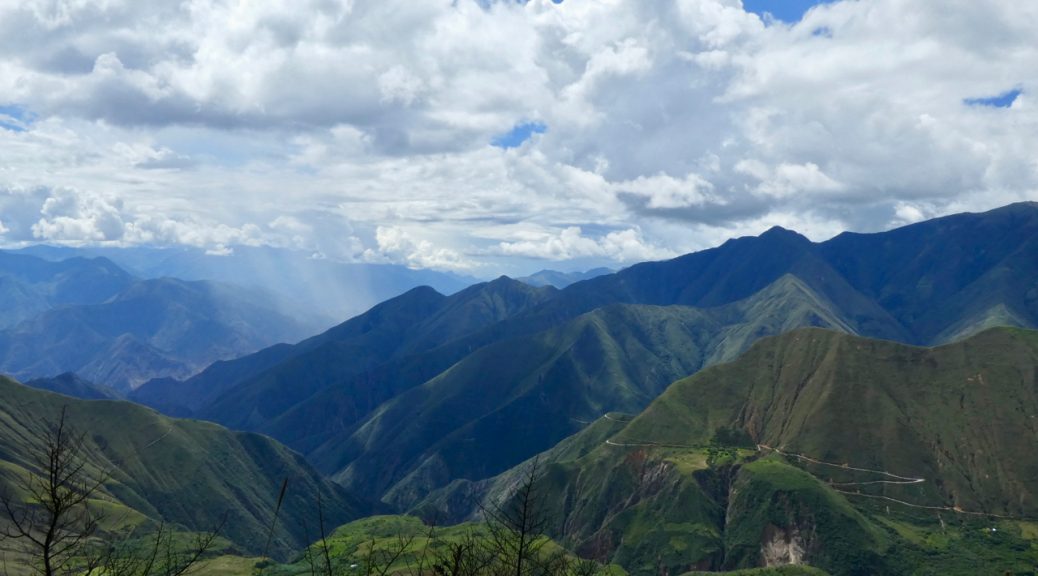
The view took our breath away. Photos really can’t capture it.
The valley floor in the foreground was maybe a 1000m below us. Our destination was the town of Balzas 2800m lower down.
Awesome.

The 64km, 2 hour freewheel down to Balzas in the valley was excellent although the increase in temperature not so excellent. 17C at the top and a sauna steamy 40C at the bottom. We’d read from an overland travel blog that there was a good wild-camping spot 5km on from Balzas; 200m higher up and in theory slightly cooler.  So once we’d fixed a slow puncture and some scumbag kids had stolen my e-cigarette, we left Balzas for our not so good as it turned out camp spot. Very rocky, very hot and very insecty. That’s a new word I just invented.

Our not so good wild-camping spot.

The following morning the alarm went off at 4:50 and we were on the road by 6:30 in a bid to try and gain a bit of altitude and cooler air before it became unbearably hot. The target for the day was the town of Celendin, 55km away and over another 3200m pass – 2100m of climbing ahead of us.

After a 1000m of climbing we or rather Steve gave up and we got a lift to Celendin and then from there, a mini-bus to Cajamarca.

We’ve been on the road for 3 1/2 months now. The cycling has been very rewarding, the countries and people experiences sublime but, we’re tired. The 2500km of cycling we’ve done so far has been very physically demanding at times and we’re now running out of energy.

We’d like to cycle a bit more – up into the Cordillera Blanca and on to the city of Huaraz where we plan to get a bus to Lima for our flight home in a couple of weeks – but have a couple of issues to contend with.

Some of the roads are very tough with some 4000m passes however, the main problem is due to the extreme rainfall northern Peru has been experiencing lately causing widespread flooding, mud slides and chaos.

There are currently no buses running from either here in Cajamarca or Huaraz to Lima because the rain has destroyed several critical roads and bridges or blocked them with mud slides! The main coast road north from Lima is closed causing major problems. 80 people have died so far, 140,000 homes destroyed or damaged and at least 650,000 people displaced or affected! Additionally, as a result of the transport issues, some food prices have increased or dropped because people can’t export their produce and fuel shortages and associated price increases are affecting some areas.

The road from Huaraz to Lima was open briefly a couple of days ago but further heavy rain has closed it again with more forecast for the next 2 weeks!

We may well be stuck and there’s a possibility that we won’t be able to get to Lima in time for our flight home!

At the moment the plan is to take a bus a bit further south then cycle the remaining 500km to Huaraz and hope that the situation improves enough over the next 10 days to allow us to get a bus to Lima.

What we don’t know is – will the roads re-open in time and if they do for how long? how many other travellers are stuck in Huaraz and will there be space on a bus if the roads do re-open? We’ll be cycling on some very tiny, high, remote dirt roads that themselves may or may not have rain-related issues. Exciting!

Watch this space!
Goodbye Ecuador, hello Peru and proper mountains!

Goodbye Ecuador, hello Peru and proper mountains!

Hola blogistas. Yep we’re still alive: some of you were worried at the lack of updates so here you go.

As you might have guessed from the title, we’re now in the land of marmalade eating bears and real mountains. Apparently, so said an Ecuadorian, Peru has proper mountains which implies that Ecuador and Colombia don’t, that we just imagined pedalling glacially up all those bloody huge hills and well, we probably don’t want to think about what’s to come.

In our last instalment we were just about to set off to circumnavigate Volcan Chimborazo, an inactive strato-volcano; the highest mountain in Ecuador (6263m) and also the highest in the world! Really! it’s true! According to the Ecuadorians, and probably a geologist or two, Chimborazo sits on the equatorial bulge which makes its summit the furtherest point on the Earth’s surface from the Earth’s centre and therefore, the highest mountain in the world. So there!

After leaving Latacunga, we made it 40km down the road to Ambato where we had to abandon the cycling due to us both feeling a bit off. After a day slothing in an hotel room (we call it recovering), the road from Ambato at 2500m, wound gently up through a gorge to 4000m into more landscape reminiscent of the Scottish highlands where we ran out of steam and semi-wild camped in a field after asking the farmer and giving him a $2 donation.

Could be Scotland or the Lakes except for the 4000m altitude.
Our portable hotel ready for occupation.

The next morning saw Chimborazo revealed through the clouds as we cycled onwards and upwards towards it and its Vicuna peppered national park.

Chimborazo drawing us ever closer.
Getting closer with Michelle cycling away as she thinks it makes a better photo…!
Vicunas
The Vicuna is a relative of the llama. Vicuñas produce small amounts of extremely fine wool, which is very expensive because the animal can only be shorn every three years, and has to be caught from the wild. When knitted together, the product of the vicuña’s wool is very soft and warm. The Inca valued vicuñas highly for their wool, and it was against the law for anyone but royalty to wear vicuña garments; today the vicuña is the national animal of Peru and appears in the Peruvian coat of arms. They have cute babies too!

Eventually we reached the official park entrance at 4350m. Whilst we were recovering and debating whether or not to try and cycle up the 8km dirt road to the Refugio and its campsite at 4880m, a local offered to take us and the bikes up ( for a small fee of course ) in the back of his truck. Feeling a bit apprehensive about the idea of camping at almost 5000m ( hey, what’s the worst that can happen? Death by hypothermia!?), we accepted his offer.

GPS altimeter seems to be a little bit out.
The camping area was another 20m or so higher than the Refugio. Had to recover a bit of breath after pushing the loaded bikes up.
Altitude. What altitude! He’s a hero.
Ice-encrusted tent in the morning with down-encrusted occupant reluctant to leave it. Thankfully, our sleeping bags were excellent again.
Stunning views from even higher up. Michelle was the hero with the camera, energy and lungs to climb further up the mountain!
Andean fox.

The following morning we cycled ( freewheeled 🙂 ) 50km downhill to Riobamba where we caught a bus to Loja in the South of Ecuador in order to save time and press on to Peru as our time left is dwindling.

From Loja we cycled to Vilcabamba, a weird little town colloquially known as Gringocabamba due to its population of white, 40 to 60 something Americans. Fortunately, just outside the town is Rumi Wilco ( https://www.rumiwilco.com ) a private 40ha eco-lodge and nature reserve that forms a part of the buffer zone of one of the world’s most biodiverse areas (Podocarpus National Park).

We spent a couple of days here camped in the forest by the river; walking the trails and generally enjoying its peace and tranquility.

Vilcabamba. The sign says: The only place in the world where it’s possible to give more years to life and more life to years! It is a common destination for tourists, in part because it is widely believed that its inhabitants grow to a very old age. Locals assert that it is not uncommon to see a person reach 100 years of age and it is claimed that many have gotten to 120, even up to 135, which would make it an area with the oldest inhabitants in the world. It is often called the Valley of Longevity.
Cycling out of Rumi Wilco on one of its trails.

A pitcher plant we think.
Colourful shield bug.
Don’t know what the plant is but the vibrant blue flower is lovely.
One of the several species of Orchid we saw in the reserve.
Spiky tree.
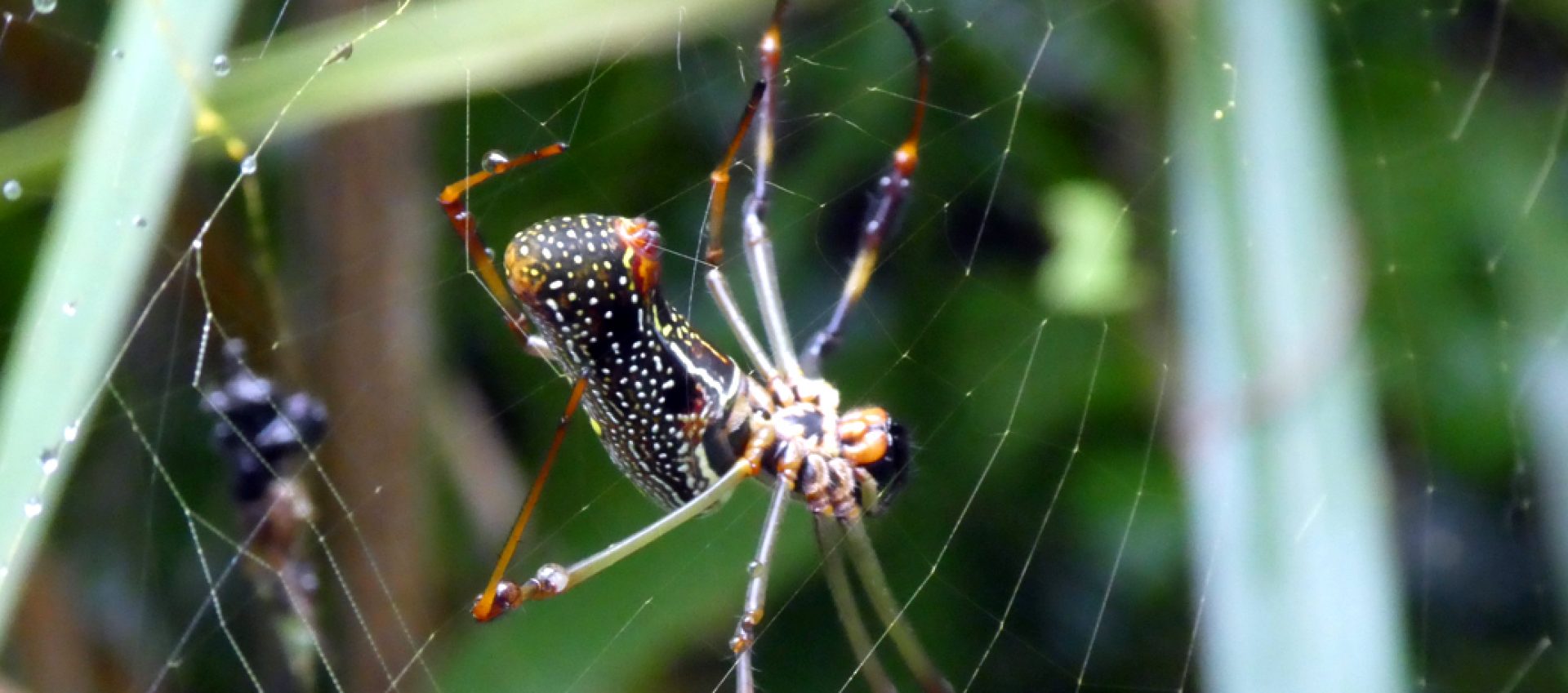
Awesome spider! Sorry for the shock all you arachnophobes! 🙂
More spider!
Wasp nest.
Transparent winged lacewing.
Camped in the forest.
Forest loo and shower!

The plan was to cycle the 150km from Vilcabamba to the quiet, non-tout, non-scammer occupied Peruvian border at La Balza however, after 20km and 850m of climbing, Steve ran out of steam so we decided to take a bus to Zumba, 117km up the road. We were glad we did. The road was extremely lumpy as in climbs of 800m+ followed by drops of the same and repeated many, many times! It might have taken us 4 days or more to do it as it’s unpaved for a large section.

After a night spent at the insect infested Hotel Emperador, we invested $20 in a private taxi to the remote border crossing shacks at La Balza rather than wait until mid afternoon for the $2.50 “Ranchero” bus/truck Ranchero bus.

On a roll with non cycling transport we then took a taxi the 47km to San Ignacio where we’re ensconced in the best hotel in town ($20 a night for a very nice double room! ) prior to heading off on the bikes tomorrow to Chachapoyas region and the monumental ruins of Kuelap, a C6th walled city that is apparently almost as good as Machu Picchu but without the hordes of tourists due to its location well off the beaten track.

The Ecuador/Peru border “town” of La Balza.
Steve cycling over the bridge and international border to Peru’s La Balza. When he went to the customs office, the official said he was going to lunch and sent Steve to the office to get his passport stamped. i.e. no customs!
Huge butterfly on the wall of an army post on the way to the border.
Butterfly detail. Amazing!

Ecuador has been interesting and fascinating but our 4 weeks there didn’t seem long enough to give us a proper feel for the country or its peoples but such are the constraints of travelling with time limits.

We only have a similar amount of time here in Peru so we may come away from here feeling a bit dissatisfied too! We’ll have to see.

Our first impressions of Peru have been good. Friendly, laid back people. It definitely appears to be much cheaper than Ecuador. We had a successful introduction to Peruvian beer but our first Peruvian meal was a bit of a failure! We thought the explanation of the meal might have been “Carne seco” dry meat, and what we got was literally dry meat – strips of meat, tougher than biltong served with a pile of fried banana strips – probably more akin to old boot leather. Notes taken to avoid in future!

Peruvian beer in our posh hotel.
Not exactly an inspiring meal!
He’s really enjoying his sole of boot….

Hasta luego for now!

Ciclistas, Cotopaxi and more bloody cobbles!

Ciclistas, Cotopaxi and more bloody cobbles!

Hello.

We thought the we might be at the Casa de Ciclistas for two or three days but broken bicycle and mechanic work load meant we were there camping in the garden for 6 days!

The Casa de Ciclistas, just outside Quito, is a rambling old hacienda-style house with an orchard, run by friendly Ecuadorian bike mechanic Santiago and his family. They have been providing hospitality for cycle-tourists for the last 25 years! We were keen to stop by as it was an opportunity to meet other cyclists, hear their stories and pick their brains about route ideas.

As it happens, Steve’s rear hub had a serious mechanical issue necessitating an emergency 15km cab ride ( both bikes sticking out of the boot! ) to the Casa. Steve’s mechanical issue required a new hub ( it had done 18000km and the Colombian/Ecuadorian roads just finished it off.. ) and the wheel to be re-built. A visit to the “Casa” was a timely event. Apart from getting the bike fixed, we met some great characters, went to a party and visited Quito.

The “Bunker” a dim, concrete cellar where the ciclistas keep their bikes, cook their food, talk about all things cycling and draw or write messages on the wall.
Santiago A.K.A The Godfather of cyclists in Ecuador, busy at work.
Michelle wanted to clean her bike. Santiago insisted that she virtually strip the whole bike and do a proper job! Steve decided not to get involved with any cleaning.
A creatively painted bike owned by Pancho, one of the Argentinians’.
Another bike with a creative pannier solution.
Benoit, a French cyclist chilling with Atti, one of the Casa hounds.
Jaime, an Argentinian cyclist working on his bike.
Jaime and Letty from Belgium in the bunker!
Pancho, bike mechanicing.
Group departure photo for a couple of French cyclists.
Leajandro, yet another Argentinian cyclist enjoying himself at the party. He also makes great pizza!
Danny and Ana, Santiago’s daughter after several shots of a potent sugar-cane derived spirit.
Gabi, another Argentinian cyclist and great character. He’d been there two months working as Santiago’s assistant to earn himself the bits to build a new bike with which to continue his journey.
Steve making friends with Atti. He likes cats really but can’t say no to the odd friendly dog! Don’t tell Ziggy!

So, after 6 lovely restful days we wrenched ourselves away from the Casa and continued our journey south with Cotopaxi national park as our next destination at the end of yet another vertically steep cobbled ( what is it with the Ecuadorians and bloody cobbles?! ) Ecuadorian road.

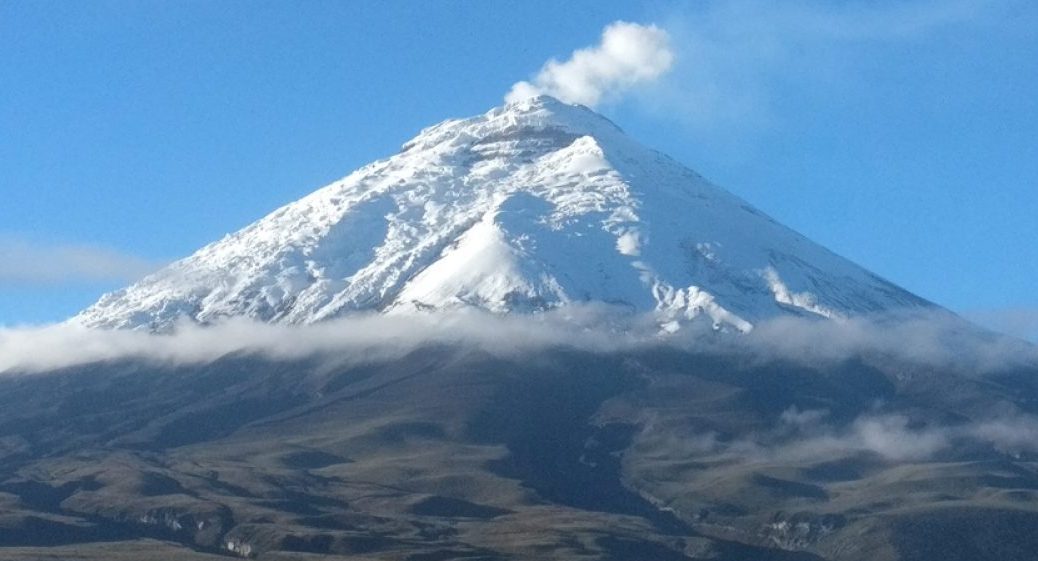
Cotopaxi volcano. 6000m high and normally shrouded in cloud but revealed especially just for us.
Bikes propped up next to one of the many huge rocks ejected by the volcano. Wouldn’t want to be in the vicinity when they were raining down!
Back on the road again. A happy cyclist with a cloud covered Cotopaxi in the background.
Another view of the majestic Cotopaxi.

We thought the landscape looked a bit like Scotland ( mist, cloud, rain and big empty beautiful landscapes ) except for the 6000m volcano obviously!

We’re now in Latacunga planning to get up close and personal with Volcan Chimborazo by cycling around it and up and over a couple of 4000m + passes.